
By Kylee Duberstein, Ph.D., Equine Extension Specialist, University of Georgia
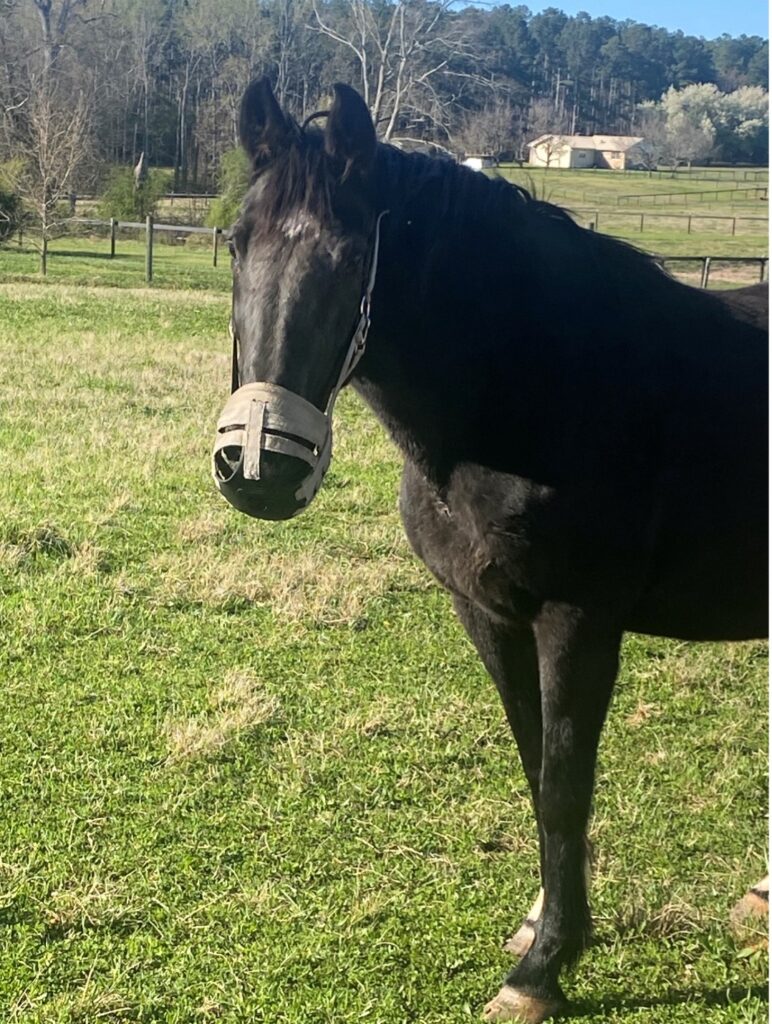
As spring approaches and grass becomes more abundant in pastures, we have reached the season where horse owners often start reaching for muzzles to curb weight gain in their pastured horses. While muzzles can be unpopular among some horse owners due to the perceived frustration, stress, and discomfort they may cause to the horse, the reality is that they are a very practical tool in equine management. Muzzles, when used correctly, aid in the management of potentially severe health problems in horses that are prone to obesity, metabolic disorders, and/or laminitis. In this newsletter article, we will discuss some of the reasons for muzzling horses, as well as recent research on the effectiveness and welfare of muzzling.
Why muzzle?
One of the most common reasons for muzzling horses in a pasture setting is to reduce the risk of laminitis, especially in obese and/or insulin dysregulated horses. Laminitis can be caused by a variety of triggers, but endocrinopathic laminitis is far and away is the most prevalent form, accounting for as many as 90% of laminitis cases. What is endocrinopathic laminitis? This simply refers to laminitis that results from endocrine related disorders in the horse, namely Equine Metabolic Syndrome (EMS) or Pituitary Pars Intermedia Dysfunction (PPID, commonly called “Cushings”). Insulin dysregulation is the hallmark sign of EMS, and it is typically a result of obesity, potentially combined with regular increased levels of dietary non-structural carbohydrates (NSC). NSCs are the component of the diet that most increases blood sugar levels, and this, in turn, signals the body to produce more insulin. High levels of insulin in the bloodstream are known to trigger laminitis bouts in horses. For horses that are insulin dysregulated, a diet high in NSC’s can cause them to produce much higher than normal levels of insulin as compared to healthy horses. These high levels of insulin directly damage the hooves and cause laminitis if they are extreme and/or persist over time.
In EMS horses, this condition often develops over time, with obesity and middle age (10-20 years old) increasing the risk of insulin dysregulation and laminitis predisposition. PPID, by comparison, is a condition that is often accompanied by advancing age (onset is usually >20 years old) in which degeneration of dopamine producing cells in the brain sets of a disruption in hormone pathways which may, in turn, result in insulin dysregulation. It is important to note that horses can also develop insulin dysregulation and require dietary management without being overweight. However, for most horses, obesity is a primary driver of insulin dysregulation, and therefore, weight management is a very effective tool in managing laminitis prone horses.
How do muzzles help?
Muzzles are effective tools in managing laminitis in two main ways. The first is that, when used correctly, they reduce dietary intake and therefore may promote weight loss, or at least minimize weight gain. The second benefit to muzzling laminitis-predisposed horses is that they reduce the intake of grass, which is very high in NSC, and therefore may stabilize blood insulin levels. However, horse owners often have questions on how to properly muzzle their horse. For example, should the horse be muzzled all day, or only a portion of the day? Does the horse need to be removed from the pasture any time it is not muzzled, or is it possible to free graze the horse for part of the day and still reap some benefits of muzzles? And, of course, does my horse mind wearing a muzzle?
What does the research show?
In 2015, the National Equine Welfare Council recommended that horses should not wear muzzles for more than 10-12 hours per day due to potential welfare concerns associated with wearing muzzles continuously. However, this immediately led to research into both the effectiveness of short-term muzzling as well as the welfare of horses wearing muzzles continuously.
A study on obese ponies published in 2016 compared weight gain in unmuzzled ponies to ponies that were muzzled 10 hours per day for a 3-week period. While both treatment groups gained weight over the study, the unmuzzled horses gained significantly more weight than those that were muzzled for 10 hr/day, indicating that half-day muzzling may provide some effectiveness. It is important to note that this study did not compare results to horses that were muzzled 24 hr/day. A more recent study conducted in 2020 on miniature horses did make this comparison by using three treatment groups in their study: unmuzzled horses compared to horses that were muzzled either 10 hr/day or 24 hr/day. This study found that horses that were muzzled 24 hr/day showed a decrease in body weight, whereas horses that were muzzled for 10 hr/day or left unmuzzled showed a significant increase in body weight by comparison. Additionally, horses in this study were monitored for signs of physiological stress during muzzling periods. Muzzling for 24 hr/day did affect some behaviors, namely resulting in a reduction in grooming behavior among muzzled horses. However, physiological measures of stress showed no negative impact of continuous muzzling; namely, salivary cortisol levels (an indicator of stress) were not different between muzzled and unmuzzled horses, and horses muzzled 24 hr/day actually had a reduced heart rate and an increased beat-to-beat interval as compared to unmuzzled horses, both of which are generally associated with reduced stress and improved health. While some behavioral differences were noted between treatment groups in the amount of time spent walking, trotting, and cantering (on average, unmuzzled horses spent more time in these gaits as compared to muzzled horses), there was no statistically significant differences in the total amount of distance traveled each day by muzzled and unmuzzled horses.
While best management practices for muzzle use are still evolving, it is important to note that muzzling for only part of the day may not be effective in inducing weight loss unless the horse is removed from pasture during the unmuzzled portion of the day. One strategy that is often implemented is to have the horse muzzled during the part of the day when on pasture and unmuzzled during time spent in a stall or dry lot. However, for those who do not have access to a stall or dry lot, recent research seems to indicate no adverse effects associated with continuous muzzling, though studies so far have been very small and need to be expanded to confirm these findings. Other research has shown that horses have the highest feeding activity at dawn and dusk, and lowest at midmorning to midafternoon, potentially providing useful information as to when timing of muzzle use might be most effective. However, research has not been done to see how horses alter their feeding activity when muzzled during different times of the day. Another consideration of pasture grazing and muzzle timing is that NSC levels on a non-freezing day tend to be highest in the afternoon, so this is potentially the time of day when insulin levels could be most elevated if horses feed during this time. However, again, there have not been good, research- based guidelines on if there is a best time to allow horses to free graze if you are choosing to muzzle for only part of the day.
How to muzzle?
There are many styles of muzzles available for purchase as well as online tutorials on how to properly fit a muzzle. General recommendations are to select a muzzle that allows for approximately two finger widths of space (approximately 1 inch) between the muzzle and the nose of the horse, as well as between the bottom of the horse’s chin and the grazing muzzle (e.g. so that the bottom of the muzzle does not contact the horse’s face when the horse is in a relaxed non-grazing position). The horse should easily be able to open its mouth, and its breathing and drinking should not be impacted by a properly fitting muzzle. It is important to check the horse for rubs regularly (at least daily), especially if the horse is wearing the muzzle for a prolonged period.
Summary
In summary, although the muzzle may at first glance appear to be an uncomfortable and unappealing device to subject your horse to, it is actually well tolerated by most horses. Research has shown it to be an effective tool in reducing pasture intake, making it effective in managing obese horses and helping in the prevention of laminitis. While questions still exist as to exactly how long and when the horse should be muzzled, there is a growing body of research that is starting to answer these questions.
References:
- Efficacy of wearing grazing muzzles for 10 hours per day on controlling bodyweight on pastured ponies. 2016. Longland, AC, Barfoot, C, Harris, PA. Journal of Equine Veterinary Science, vol 45, pgs 22-27.
- Effects of grazing muzzles on behavior, voluntary exercise, and physiological stress of miniature horses housed in a herd. 2020. Davis, KM, Iwaniuk, ME, Dennis, RL, Harris, PA, Burk, AO. Applied Animal Behavior Science, vol 232.
- Effects of grazing muzzles on behavior and physiological stress of individually housed grazing miniature horses. 2020. Davis, KM, Iwaniuk, ME, Dennis, RL, Harris, PA, Burk, AO. Applied Animal Behavior Science, vol 231.
